How I'd Try to Get 1,000 Followers on X in 30 Days as a Developer-Founder
You don't need to become a content creator to build an audience as a developer-founder. You can make your product the content — here's how I'd actually do it.
There's something I've noticed about developers who become founders.
We spend months building the product. We think about architecture, fix bugs at 2 AM, redesign things that nobody asked us to redesign, celebrate when a feature finally works, and then one day we realize something nobody really warned us about.
We also have to market the thing.
That's where a lot of developer-founders get stuck.
You know how to build. You might even know exactly what your product does and why someone should use it. But building a personal brand on X feels like a completely different job.
You open X and see founders posting every day. Product screenshots, launch announcements, build-in-public updates, videos, threads, memes, customer wins.
Then you look at your own product and think, "What the hell am I supposed to post today?" 😭
So you post something like, "Added dark mode today."
Maybe you get a few likes.
Then you disappear for five days because you're back to coding.
I think there's a much simpler way to approach this.
You don't need to become a content creator. You can make your product the content.
That's the biggest change I would make if I were trying to grow a developer-founder account from zero to 1,000 followers in 30 days.
Not by pretending to be a marketing expert. Not by posting motivational quotes every morning. Not by spending three hours designing every single post.
Just by showing what I'm already building.
Your product is already giving you content
Imagine you're building a SaaS product.
Today you redesign the dashboard. Tomorrow you add a new onboarding flow. The next day you improve search. Then you fix a really annoying bug. Then you launch a new feature. Then you change the landing page. Then you get your first customer.
Every one of those things can become a post.
The problem is that developers usually describe what they built instead of showing it.
You might write, "Improved the onboarding experience today."
That's fine, but imagine opening your product and recording the actual improvement.
Show the old version. Then show the new version.
Now people don't have to imagine what changed. They can actually see it.
And that's why I think product videos are such a powerful format for developer-founders.
If you're building a web app, a tool like Screen Studio can make it really easy to record your product and turn an interaction into something worth watching. You can record the screen, zoom into the important part and make a simple product update look much better without turning it into a two-hour editing project.
You don't need to make a cinematic masterpiece.
Sometimes the post can simply be: "Spent the last two days fixing this onboarding flow. Here's what changed."
And then show it.
That is already content.
Mobile developers have the same problem, maybe even worse
If you're building a mobile app, the natural place to record your product is your phone.
But the moment you want to make that recording look good, the workflow becomes unnecessarily complicated.
You record the app on your phone, send the recording somewhere, move it to your laptop, open an editor, import the video, find a phone mockup, fix the framing, add a background, add some zooms, export it, notice something looks wrong, and then do it again.
Your "quick product demo" somehow became a two-hour editing session.
That was actually one of the reasons I started building MobileStudio.
I kept thinking, if I'm building a mobile app on my phone, why do I have to leave my phone just to make a good video of my phone?
The idea is simple. Record the app, clean up the recording, add a little zoom where it matters, put it into a nice phone mockup, choose a background and export it.
The important part isn't having a hundred editing features.
The important part is making the process easy enough that you'll actually do it again tomorrow.
Because that's where I think most developer-founders lose. They don't have a lack of things to talk about. They have too much friction between building something and sharing it.
The goal isn't one perfect post
I think a lot of developers approach personal branding backwards.
They try to create one amazing post, spend three hours on it, get 800 impressions, and then don't post again for a week.
I'd rather build a system where I can create something useful in 10 or 20 minutes and keep doing it.
Let's say you're building a product.
On Monday, you redesign the onboarding. Record it and post: "Spent today fixing our onboarding. The old version was confusing as hell. This feels much better."
On Tuesday, you finally fix a bug that has been annoying you for three days. Record the bug and the fix.
On Wednesday, you launch a new feature. Don't write five paragraphs explaining it. Show it working.
On Thursday, you can show how the product looked two weeks ago compared to today.
On Friday, maybe someone asks you why you built a particular feature. That's a post too.
Suddenly you don't need to sit down every morning and invent "content ideas." You're just documenting the work you're already doing.
And that's a much easier habit for a developer to maintain.
Why I would use video more often
There's a big difference between telling people that you improved something and actually showing them the improvement.
A screenshot can show what your product looks like. A GIF can show a small interaction. But a video can show the whole thing — the interaction, the transition, the before and after, the important detail, the way the product actually feels when someone uses it.
I'm not saying every video will go viral. It won't.
A bad video is still a bad post. Your hook matters. The idea matters. Timing matters. Your audience matters.
But if you've spent three days building something interesting, why describe it in one sentence when you can show someone exactly what you built?
That's the advantage of video. It gives the person scrolling a reason to stop for a few more seconds and understand what you've made.
And for a developer-founder, that's incredibly useful because the product itself becomes the visual content.
You don't need to become a designer just to show your product. You don't need to learn After Effects. You don't need to spend your evening creating some fancy promotional animation.
Just show the thing.
Then remove the boring parts
There is still another problem.
Even when you know what to post, you have to write it, improve it, schedule it, find ideas, engage with people and keep doing it consistently.
This is where I'd use something like SupaBird.
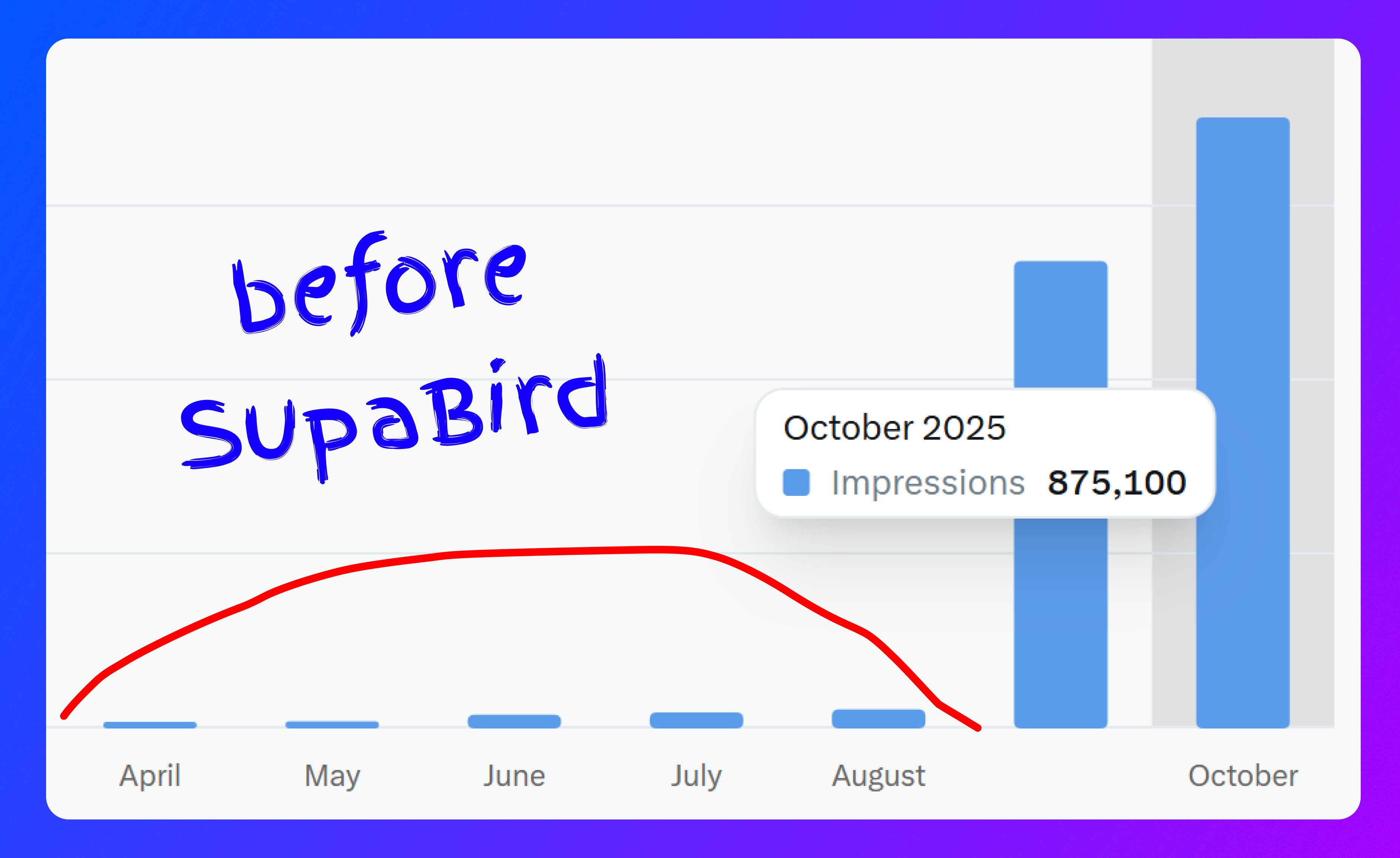
The idea isn't to let AI pretend to be me. I wouldn't want some tool writing completely fake founder stories on my behalf.
I'd use it to reduce the boring parts around the content I already have.
For example, I ship a feature and record a 20-second demo. That one piece of work can become an X post, a longer story, a screenshot post, a reply to someone asking about the problem, or even a future article.
The product work stays the same. I'm just getting more value from the work I've already done.
That's a much better use of AI than waking up every morning and asking, "Give me 10 viral tweets." 😂
You don't have to share everything
I also don't think "building in public" means sharing every commit you make.
You don't need to post every time you change a button. You don't need to turn your entire life into content.
Instead, look for moments that naturally have a story.
Something you struggled with. Something you learned. Something you changed. Something that surprised you. Something a customer asked for. Something that looked terrible before and looks good now. Something you built in a weekend. Something you almost deleted. Something that finally worked after three days of debugging.
Those are the things people can connect with.
Because when you're building in public, people aren't only following your product. They're following the person building it.
That's the part I think developer-founders sometimes underestimate. Your audience doesn't need you to be an expert at everything. They just need a reason to care about what you're doing.
So what would I actually do for 30 days?
I wouldn't promise myself that I'll get 1,000 followers. You can't control that number.
I'd make 1,000 followers the target, but I'd measure myself on something I can actually control: showing up consistently.
For 30 days, I'd build something, record something and share something.
Maybe it's a 15-second product demo. Maybe it's a before-and-after. Maybe it's a bug I finally fixed. Maybe it's a lesson I learned while building. Maybe it's a screenshot. Maybe it's a completely honest post saying, "I spent four hours fixing something that looked like a ten-minute problem."
That's relatable because every developer knows exactly what that feels like.
I'd also spend time replying to other builders instead of only talking about myself. If you're trying to build an audience on X, you don't want to just broadcast into the void. You want to become part of the conversations happening around the things you're interested in.
And I'd use tools to reduce the friction.
If I'm building a web product, I might use Screen Studio to record polished demos.
If I'm building a mobile app, I'd use MobileStudio to record and turn those recordings into clean product videos without leaving my phone.
And I'd use SupaBird to help with the planning, writing and distribution side.
The tools aren't the strategy. The product is the strategy. The tools just make it easier to keep showing up.
You don't need to become a marketer
I think this is the biggest thing I'd want another developer-founder to understand.
You don't need to become a marketer before you start marketing. You don't need a perfect personal brand. You don't need a beautiful logo. You don't need 10,000 followers before people care about what you're building.
And you definitely don't need to wait until your product is finished.
Your product is already giving you stories.
You're building something. Show it.
You changed something. Show it.
You broke something. Talk about it.
You learned something. Share it.
You shipped something. Celebrate it.
You don't have to become an influencer. You just need to make sure that while you're quietly building something in your editor, someone on the internet knows you're building it.
Because there are thousands of developers building interesting products every day. Most of them are invisible. Not because their products are bad. Not because they're bad founders. They simply aren't showing people what they're building.
So if I were starting a developer-founder account today, I'd give myself one simple rule for the next 30 days:
Don't just build in silence.
Build. Record. Share. Repeat.
Maybe that gets me to 1,000 followers. Maybe it doesn't.
But after 30 days, I'll have a product that's better, an audience that knows who I am, and a library of content showing the journey.
And honestly, that sounds much better than spending three hours editing one 20-second product demo. 🚀
If you want to see what "make your product the content" looks like in practice, join the MobileStudio waitlist, or look through real demo videos made with it so far.